
Choosing navy blue kitchen cabinets often comes down to one concern: how to use such a deep color without making the room feel dark or overly formal.
The answer depends on the cabinet layout, available daylight, and surrounding materials.
The ideas below compare full navy kitchens, two-tone cabinets, statement islands, countertop combinations, hardware finishes, and several design styles.
Use them to identify which balance of color, warmth, and contrast suits your kitchen and how much navy you want to commit to.
1. Navy Shaker Cabinets With Crisp White Quartz
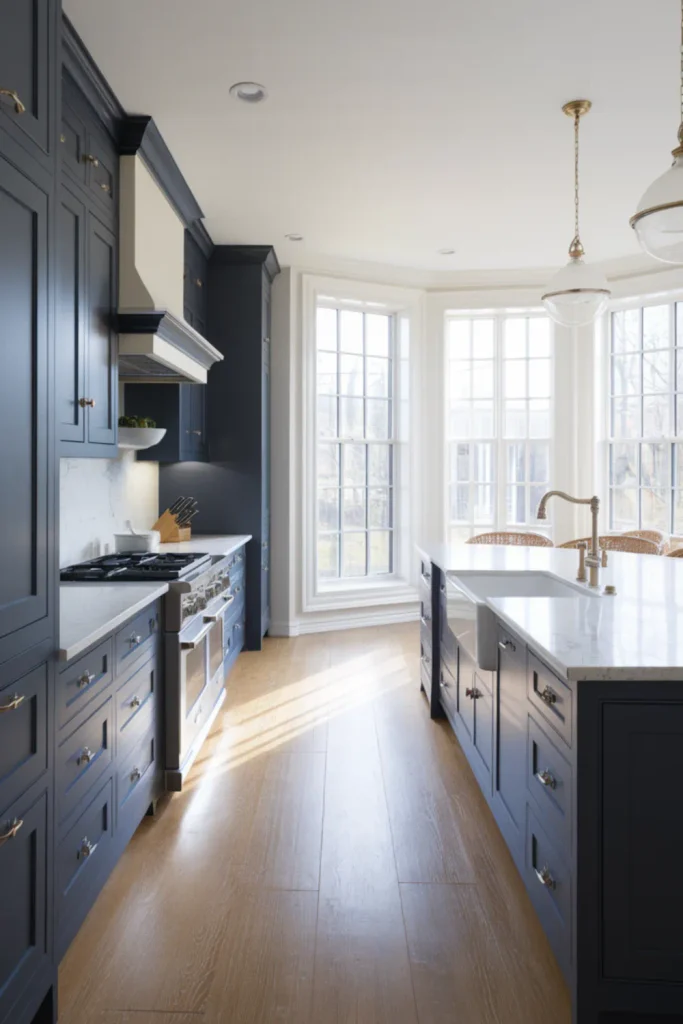
Few combinations balance drama and practicality as easily as navy Shaker cabinets with white quartz.
The dark cabinet color defines the room, while the pale counters reflect light and keep the design crisp.
Subtle gray veining works better than a busy pattern when cabinetry covers several walls.
Quartz is also easier to maintain than most natural stones, making it useful in a family kitchen.
Before choosing a navy paint color, test a large sample beside the countertop under both daylight and evening lighting.
2. Blue Lower Cabinets With Warm White Uppers
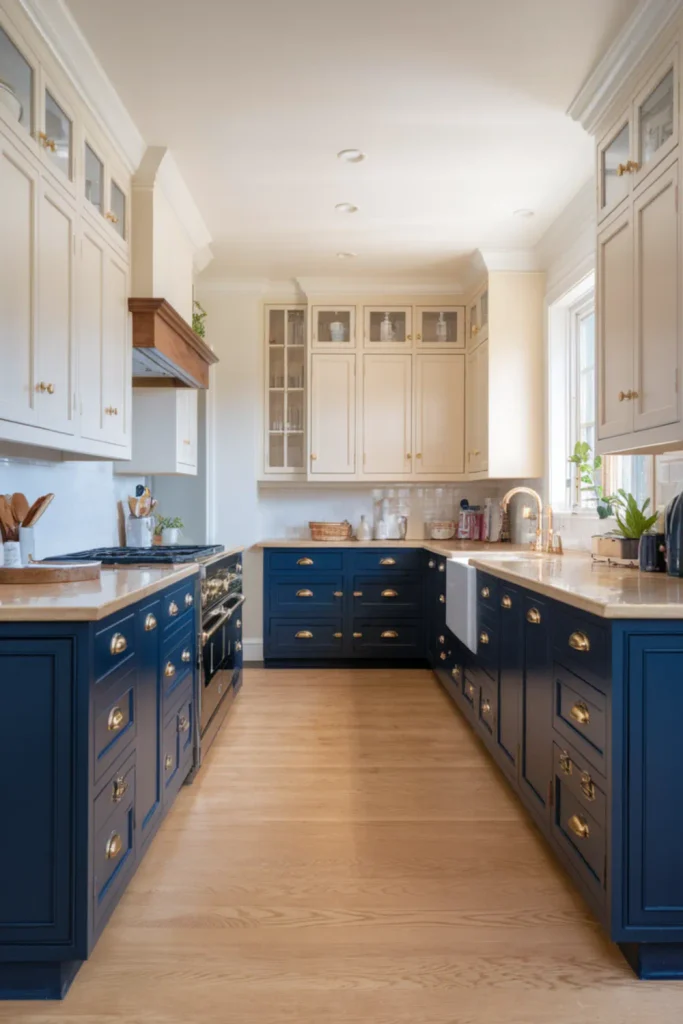
Keeping the deepest color below eye level makes navy blue kitchen cabinets easier to use in a modest-size room.
Warm white uppers preserve an open feeling, while the navy bases hide scuffs and daily wear more readily than pale cabinetry.
Choose one consistent door style and repeat the same hardware across both colors so the kitchen does not look divided.
Slightly creamy white usually pairs more naturally with navy than a stark, blue-toned white, especially when the room has oak flooring or brass details.
3. Navy Kitchen Island as the Main Color Statement
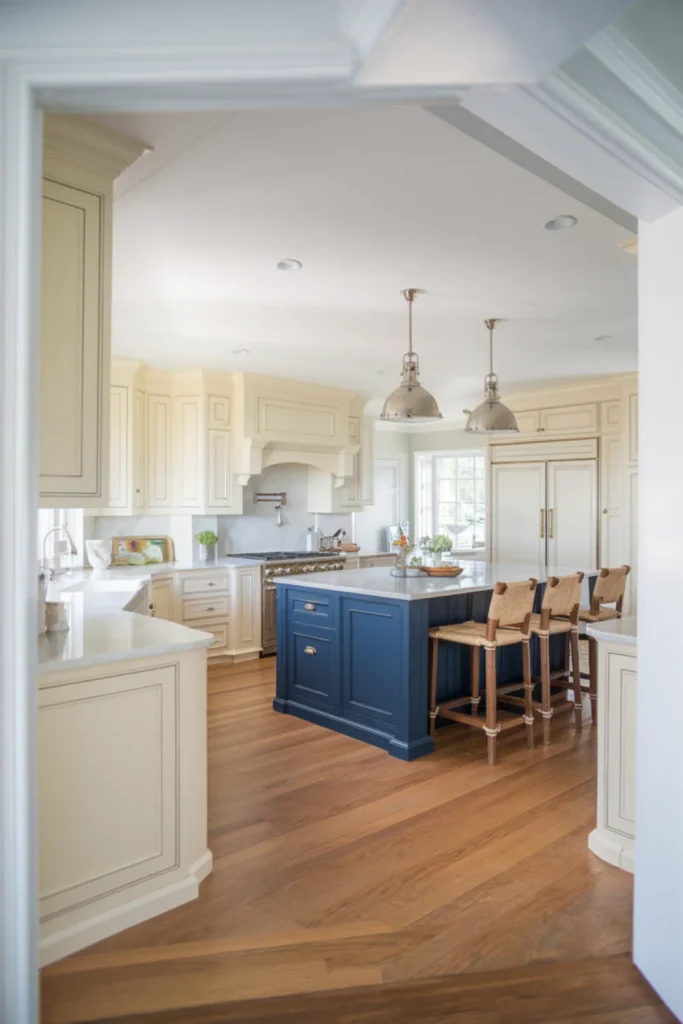
When an all-blue kitchen feels like too much commitment, a navy island offers a more controlled way to introduce color.
Surrounded by white perimeter cabinets, it becomes a clear focal point without darkening the edges of the room.
Repeat the navy once elsewhere through a pantry door, range hood, or small accessory rather than scattering blue throughout the space.
Leave at least 42 inches of clearance around the island where possible, particularly near appliances and busy walkways.
4. Navy Cabinets With Butcher Block Countertops
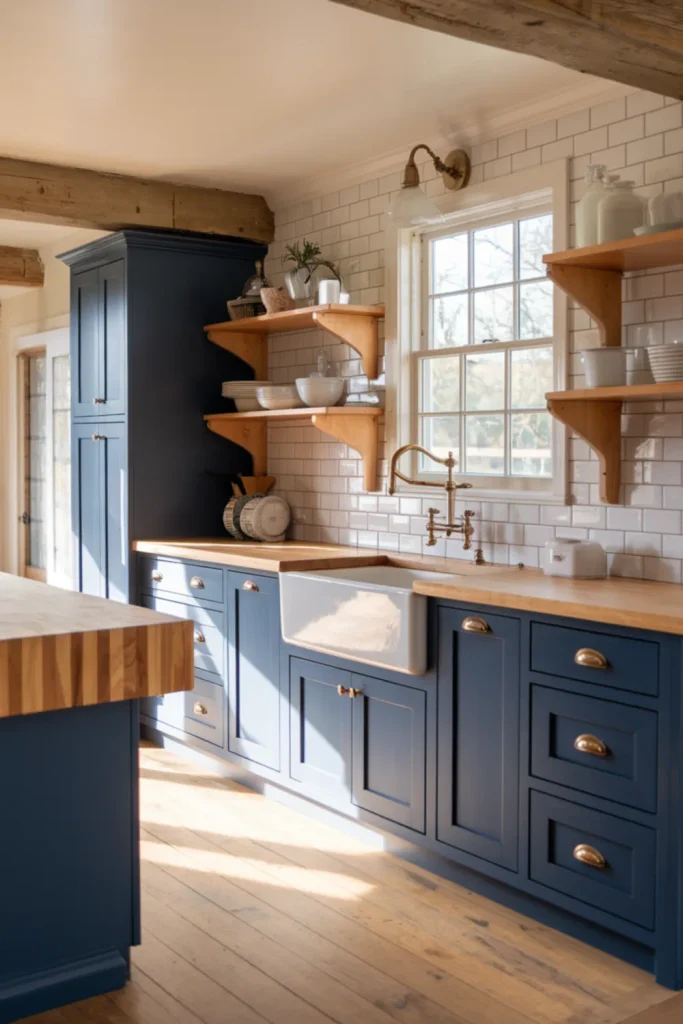
Warm butcher block gives navy kitchen cabinets a softer, more relaxed character than bright white stone.
The visible wood grain works especially well in farmhouse, cottage, and transitional kitchens with simple Shaker doors.
Maple offers a lighter contrast, while walnut produces a moodier, more layered palette.
Wood countertops need regular sealing, and standing water should be wiped up quickly around the sink.
Using butcher block on an island and a more water-resistant material along the perimeter can reduce maintenance while preserving the look.
5. Navy and Walnut Kitchen With Midcentury Warmth
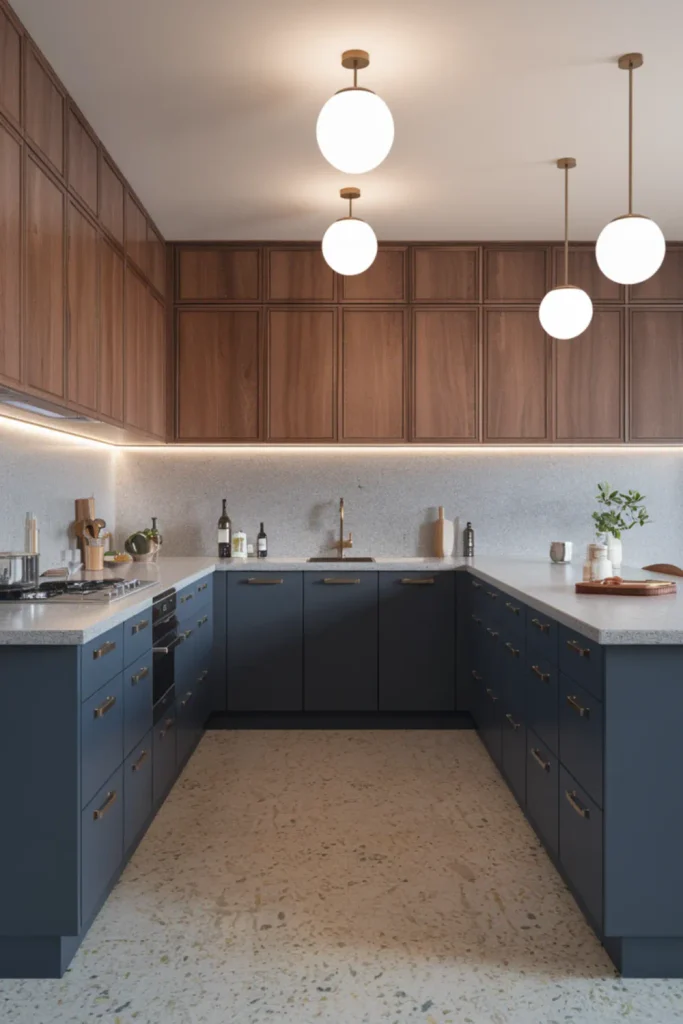
Walnut changes the way navy cabinetry reads, shifting it from crisp coastal blue toward a richer midcentury palette.
Flat-front walnut uppers paired with navy base cabinets keep the composition clean while allowing the grain to remain visible.
Pale quartz prevents both materials from making the room feel too dark.
Match the walnut undertone to nearby flooring rather than choosing two competing wood tones.
Slim pulls and simple lighting also suit this combination better than heavily decorative hardware, which can distract from the cabinetry itself.
6. Navy Cabinets With White Marble Countertops
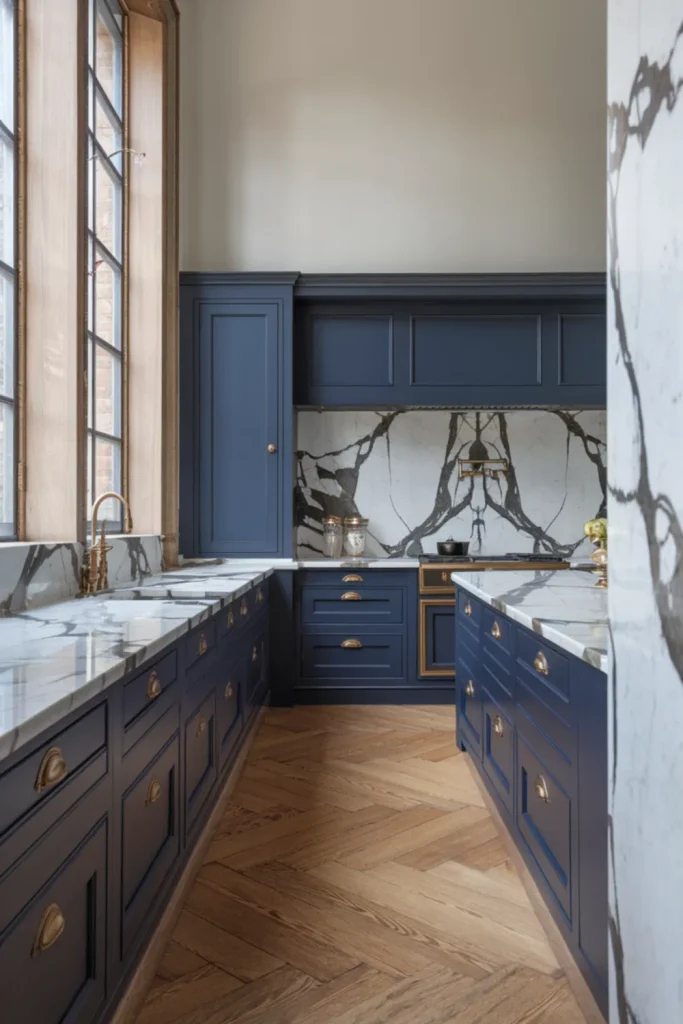
Strong marble veining gives deep navy cabinets a natural pattern without introducing another color family.
White stone brightens the work surfaces, while gray veins connect easily with nickel, chrome, or stainless steel.
A matching marble backsplash can produce a continuous look, but use a quieter slab if the countertop already has dramatic movement.
Natural marble will etch and stain more readily than quartz, so it suits homeowners comfortable with patina and regular sealing.
Always view the full slab before installation because samples rarely show its overall pattern.
7. Dark Blue Cabinets With Soft Gray Quartz
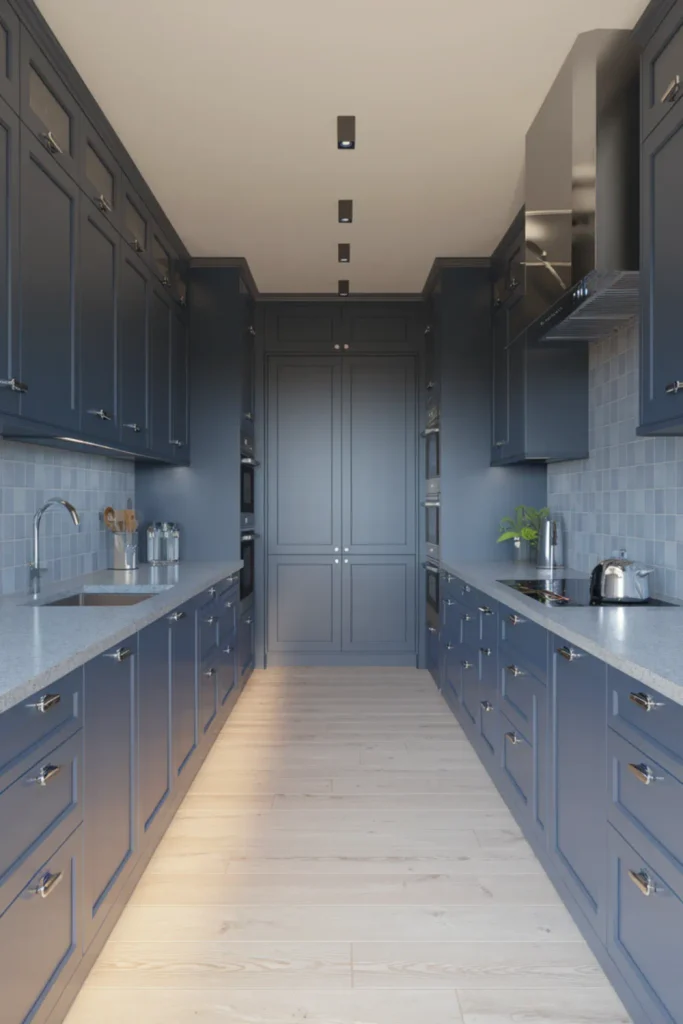
Not every dark blue kitchen needs sharp white contrast.
Soft gray quartz creates a gentler transition between navy cabinets, stainless steel appliances, and pale flooring, making the room feel more restrained.
Look for a gray surface with subtle warm undertones if the kitchen includes oak or brass.
A cold blue-gray counter beside deep blue cabinetry can make the entire palette appear flat.
Under-cabinet lighting is useful here because it reveals the distinction between the backsplash, countertop, and cabinet color after daylight fades.
8. Navy Blue Cabinets With Gold Hardware
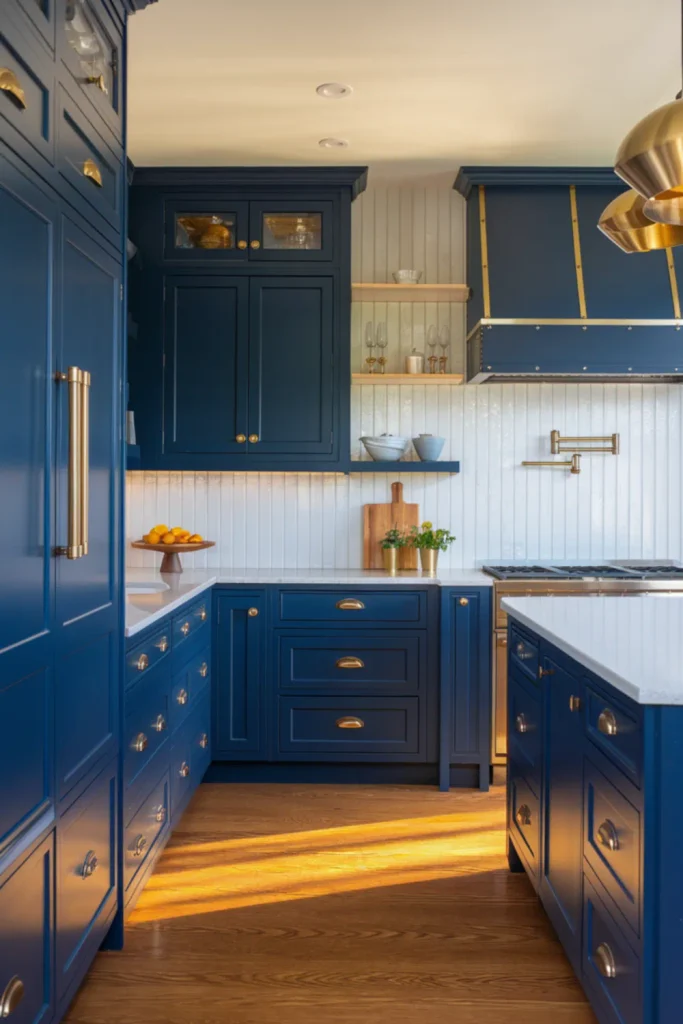
Against navy blue cabinets, gold hardware reads clearly without requiring elaborate door details.
Brushed or aged finishes tend to look softer than highly polished gold and are less likely to show fingerprints.
Repeat the metal on the faucet or pendant lights, but avoid matching every accessory exactly.
Slight variation gives the room a more collected appearance.
Hardware scale also matters: long pulls suit wide drawers, while smaller knobs keep narrow Shaker doors from looking crowded.
Order one sample before drilling an entire kitchen.
9. Navy Cabinets With Matte Black Hardware
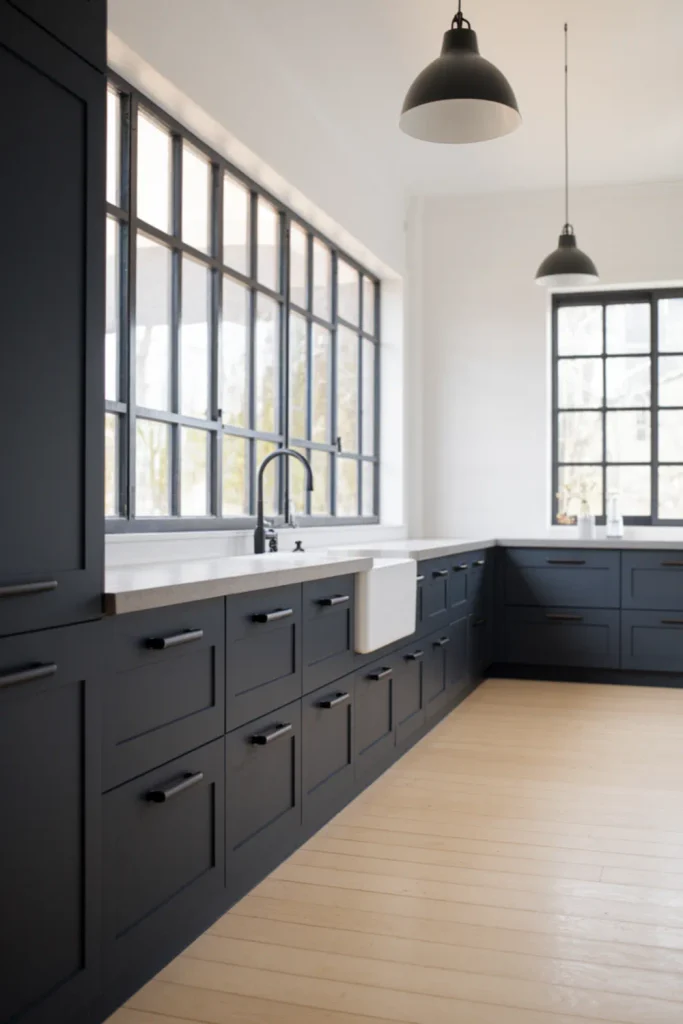
Choose matte black hardware when you want navy cabinetry to feel graphic and contemporary rather than decorative.
The contrast is subtle because both finishes are dark, so pale countertops, flooring, or walls help preserve definition.
Black pulls work particularly well with flat-panel cabinets, black-framed windows, and simple pendant lights.
Avoid combining too many nearly black surfaces in a kitchen with limited daylight.
Holding the hardware against a painted door sample will show whether it remains visible or disappears into the navy finish.
10. Navy and Brass Kitchen With White Zellige Tile
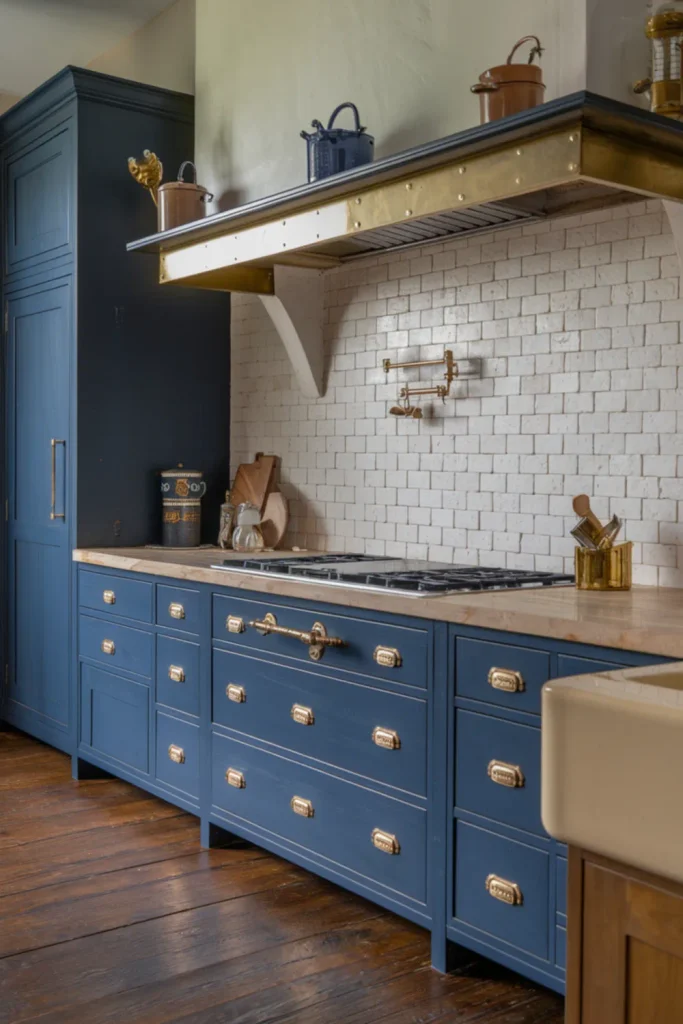
Handmade white zellige tile introduces texture through its uneven surface and shifting glaze rather than through a bold pattern.
That variation softens the formal pairing of navy and brass, especially along a compact cooking wall.
Warm grout keeps the backsplash from developing a harsh grid, while aged brass hardware echoes the tile’s handcrafted character.
Because zellige edges and thicknesses vary, installation requires more planning than standard subway tile.
Use an experienced installer and inspect several boxes together before deciding on the final layout.
11. Navy Cabinets With Stainless Steel Appliances
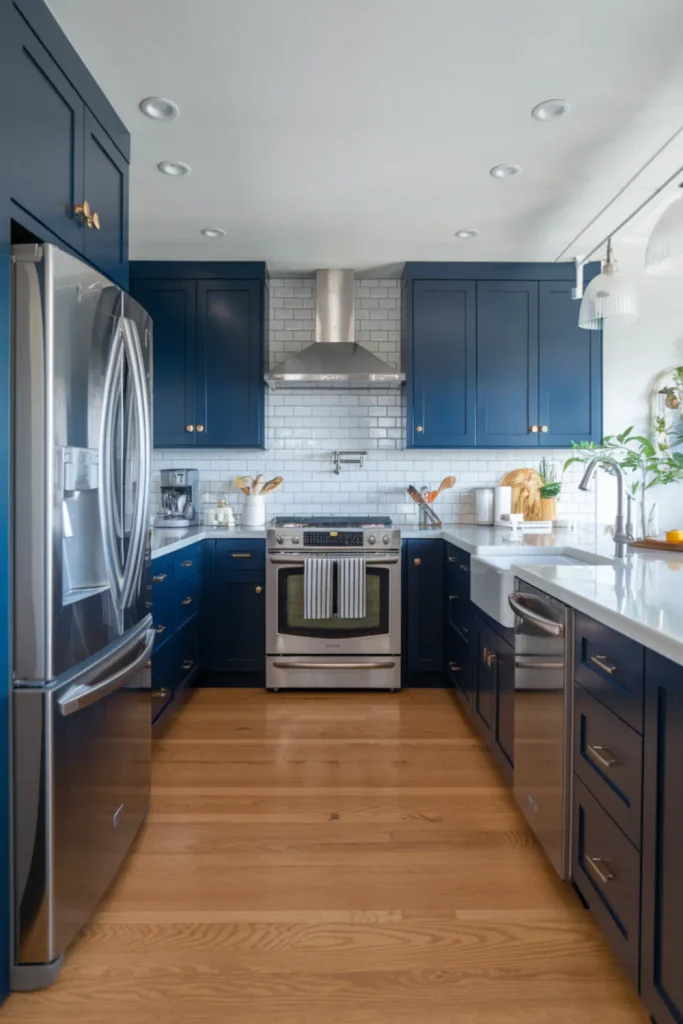
Stainless steel works as a neutral bridge between navy blue kitchen cabinets and lighter counters.
Its cool finish suits dark blue particularly well, while brushed nickel hardware can connect the appliances to the cabinet doors.
Avoid placing every large appliance in one uninterrupted row, since the reflective surfaces may dominate the cabinetry.
Paneling the dishwasher or separating the refrigerator from the range gives the blue more room to register.
Fingerprint-resistant stainless finishes are worth considering in kitchens used frequently by children or large households.
12. Navy Cabinets Paired With White Appliances
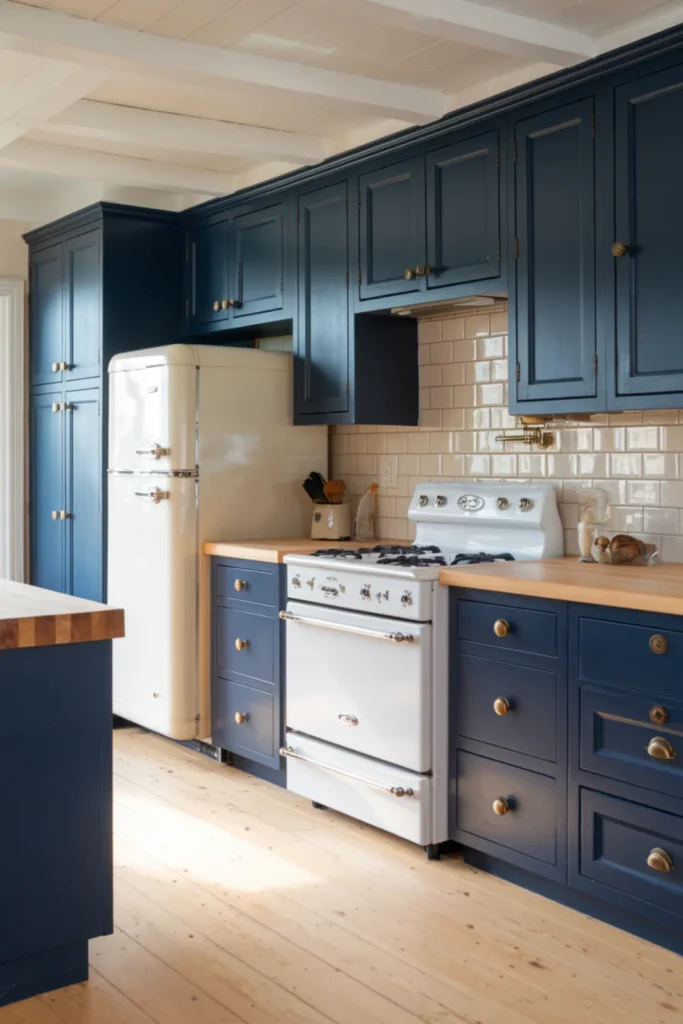
White appliances offer a softer, less industrial contrast against navy cabinets than stainless steel.
They feel especially natural in cottage kitchens with butcher block, cream tile, or warm brass knobs.
Repeating white through the sink and backsplash helps the appliances look integrated instead of randomly inserted.
Pay close attention to undertones when shopping, since bright appliance white may clash with creamy counters or walls.
Keeping the appliance style simple also prevents retro-inspired pieces from turning the entire kitchen into a theme.
13. Small Galley Kitchen With Navy Cabinets
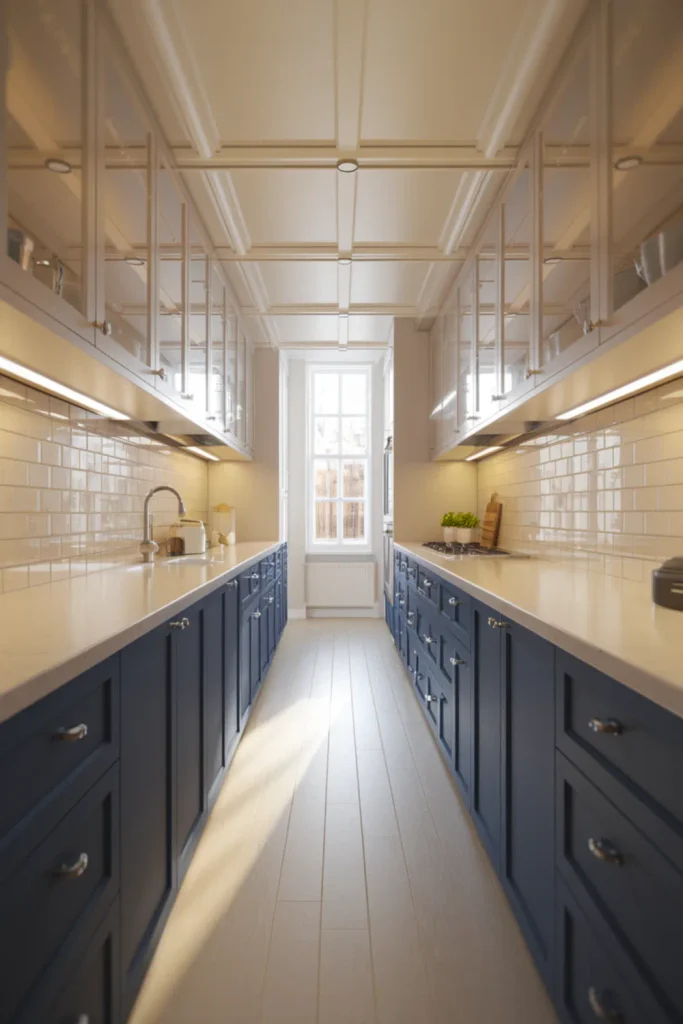
In a narrow galley, uninterrupted sightlines matter more than squeezing storage onto every available wall.
Navy lower cabinets provide color and practical closed storage, while limited white uppers keep the passage from feeling enclosed.
Running pale flooring lengthwise can visually extend the room, and glossy backsplash tile helps move light between the two cabinet runs.
Use shallow handles that will not catch clothing in the walkway.
Before finalizing the layout, check that opposing drawers and appliance doors can open without blocking each other completely.
14. L-Shaped Navy Kitchen With Open Shelving
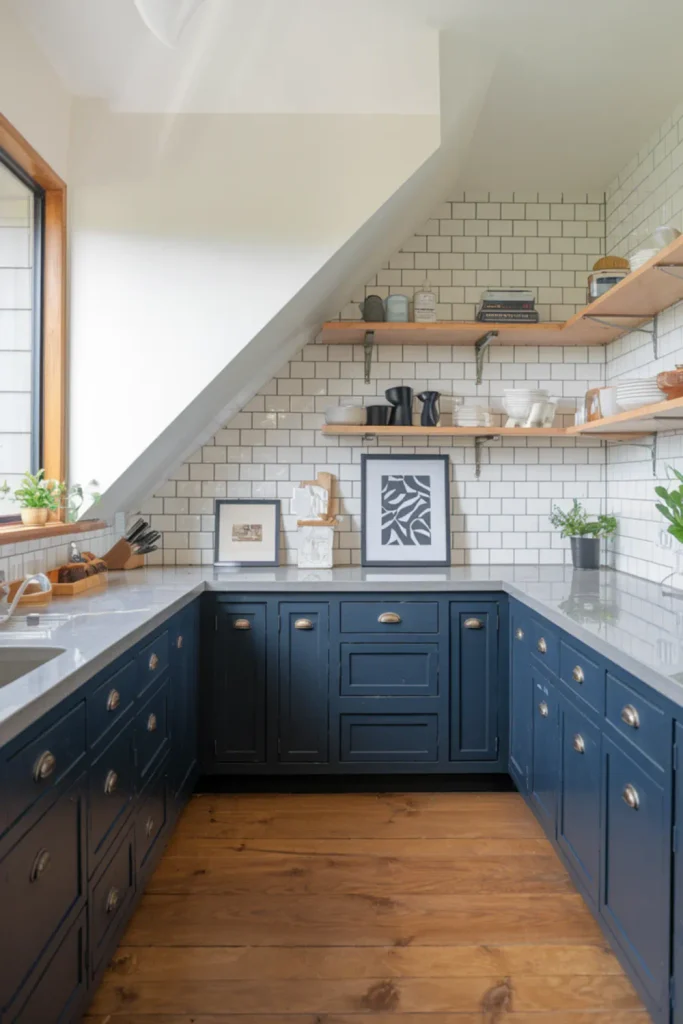
Replacing some upper cabinets with open oak shelves gives an L-shaped navy kitchen more breathing room near the corner.
The shelves can hold everyday dishes, glasses, or frequently used ingredients while the lower cabinets manage less attractive supplies.
Keep the shelf depth around 10 to 12 inches so it does not project too far over the countertop.
Too many decorative objects quickly make this arrangement feel cluttered, so prioritize useful pieces and leave some open space.
A washable backsplash also makes exposed areas easier to maintain.
15. U-Shaped Kitchen Wrapped in Deep Navy
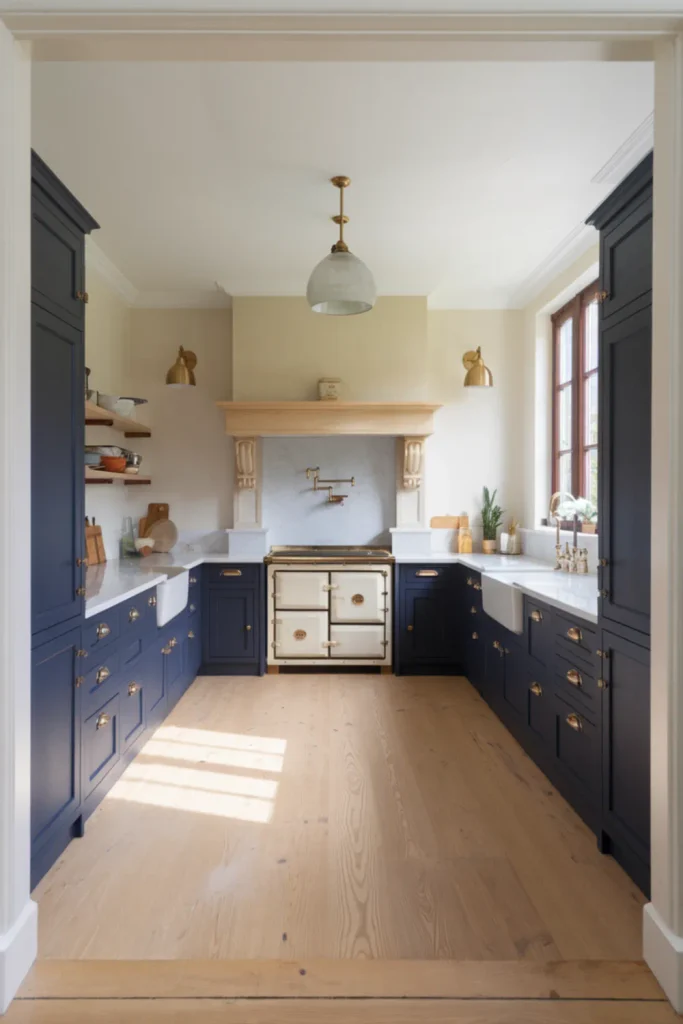
Three walls of deep navy cabinetry can provide generous storage, but the surrounding finishes need to manage its visual weight.
White counters form a continuous light band around a U-shaped kitchen, while a window above the sink breaks up the cabinet run.
Limit tall units to one side so they do not make the central work area feel boxed in.
Strong task lighting is essential beneath upper cabinets, particularly in the back corners.
Keep the main work aisles clear rather than filling the center with an undersized island.
16. Open-Plan Navy Kitchen With Natural Oak Flooring
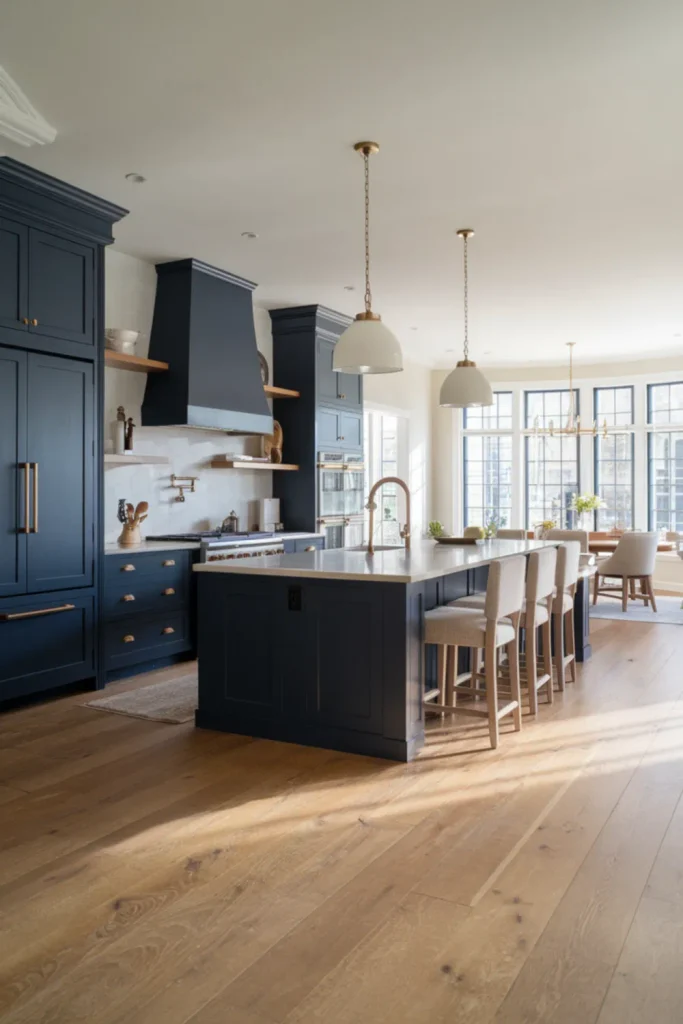
Open-plan rooms need a clear relationship between the kitchen and the adjoining living spaces.
Navy cabinetry defines the cooking zone, while continuous natural oak flooring prevents it from looking detached from the rest of the room.
Neutral stools and dining furniture let the dark blue remain the main color statement.
Check the navy from several viewing angles because it will be visible far beyond the kitchen itself.
Using the same wood tone in a nearby table or shelving unit can connect the spaces without repeating blue everywhere.
17. Floor-to-Ceiling Navy Pantry Wall
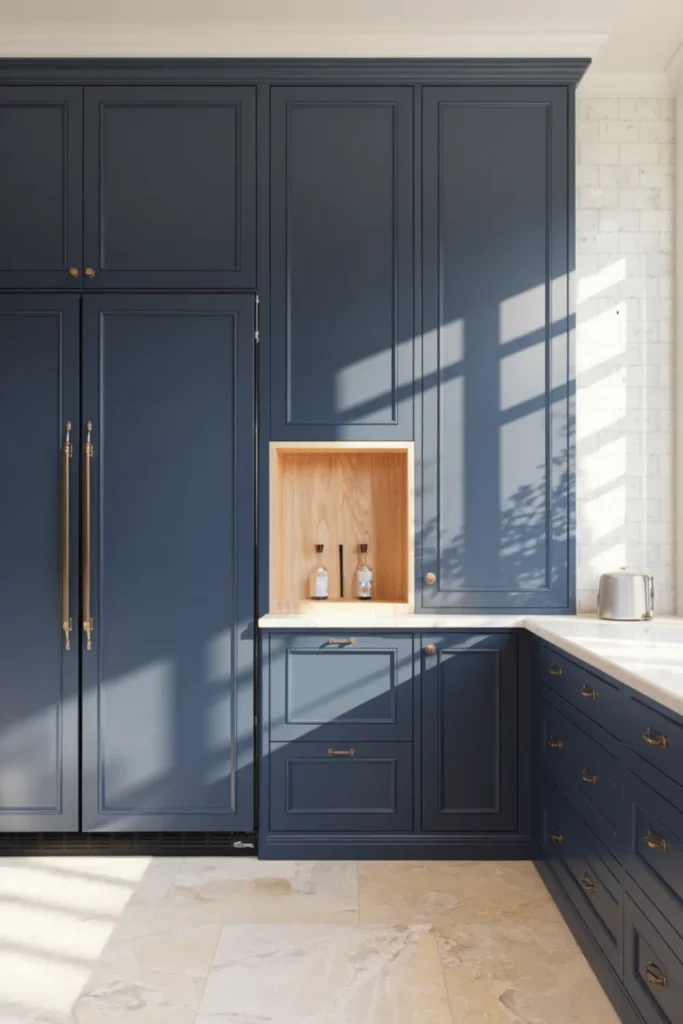
Floor-to-ceiling navy cabinets turn pantry storage and integrated appliances into one strong architectural wall.
Concealed doors reduce visual clutter, while an oak-lined coffee station or pale counter niche interrupts the dark surface where daily tasks happen.
Plan electrical outlets inside the recess before cabinetry is installed, especially for a coffee maker, toaster, or charging station.
Frequently used pantry goods should remain between waist and eye level.
Reserve the highest cabinets for serving pieces and seasonal items that do not need regular access.
18. French Navy Inset Cabinets With Traditional Details
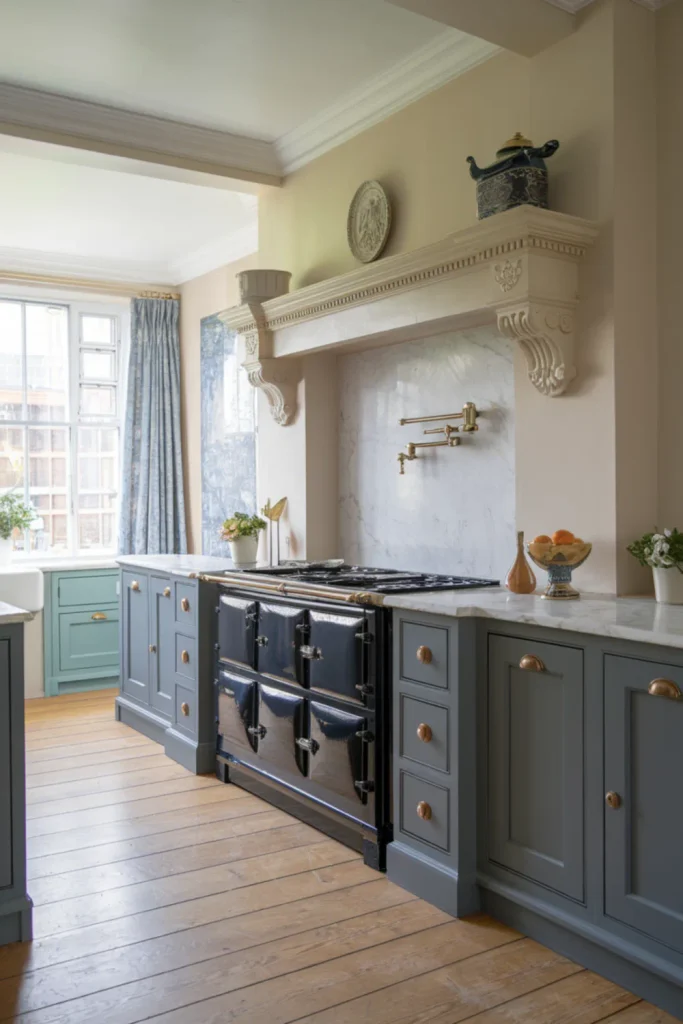
French navy sits slightly softer than an almost-black blue, which suits traditional inset cabinetry and polished nickel hardware.
Decorative toe kicks, restrained molding, and a classic range can reinforce the historic character without making the kitchen ornate.
Inset doors require precise construction because they sit within the cabinet frame and have tighter clearances than overlay doors.
Humidity changes may also affect how smoothly they open.
Pair the detailed cabinetry with quiet counters and walls so the craftsmanship, rather than excessive decoration, holds attention.
19. Midnight Blue Flat-Panel Cabinets
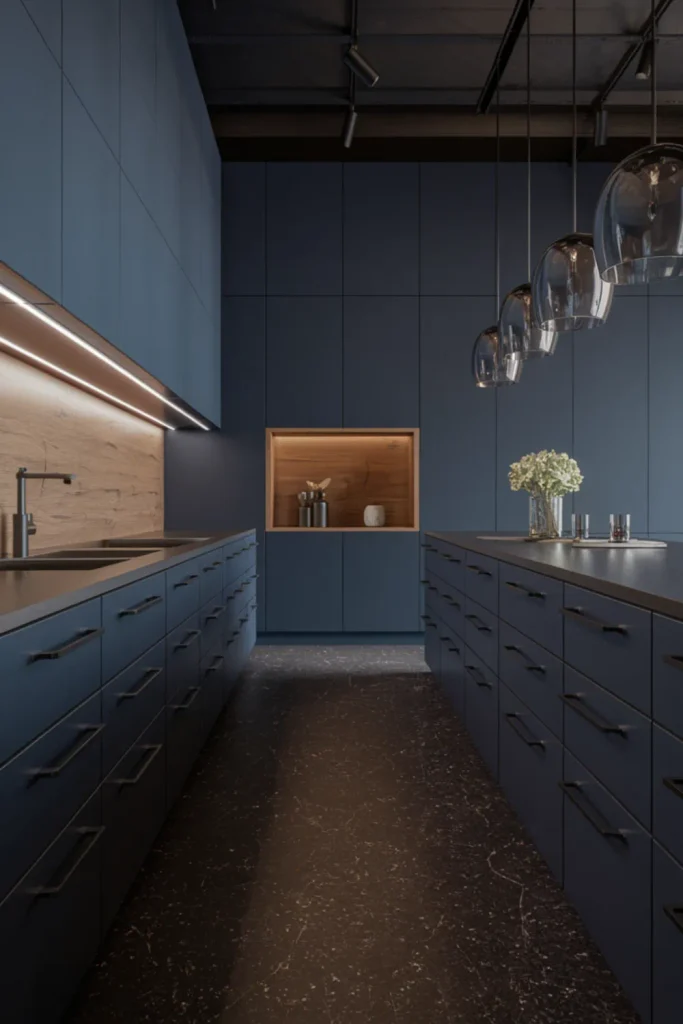
Nearly black in dim light, midnight blue gives flat-panel kitchen cabinets a strong architectural quality.
Handleless doors and narrow shadow lines support the streamlined look, while a walnut niche or pale countertop prevents the composition from becoming a single dark block.
Fingerprints and dust may show more readily on smooth matte finishes, so request a cabinet sample and test how easily it cleans.
Layered lighting also matters: combine ceiling fixtures, task lighting, and subtle niche illumination rather than depending on one overhead source.
20. Modern Navy Island With a Waterfall Countertop
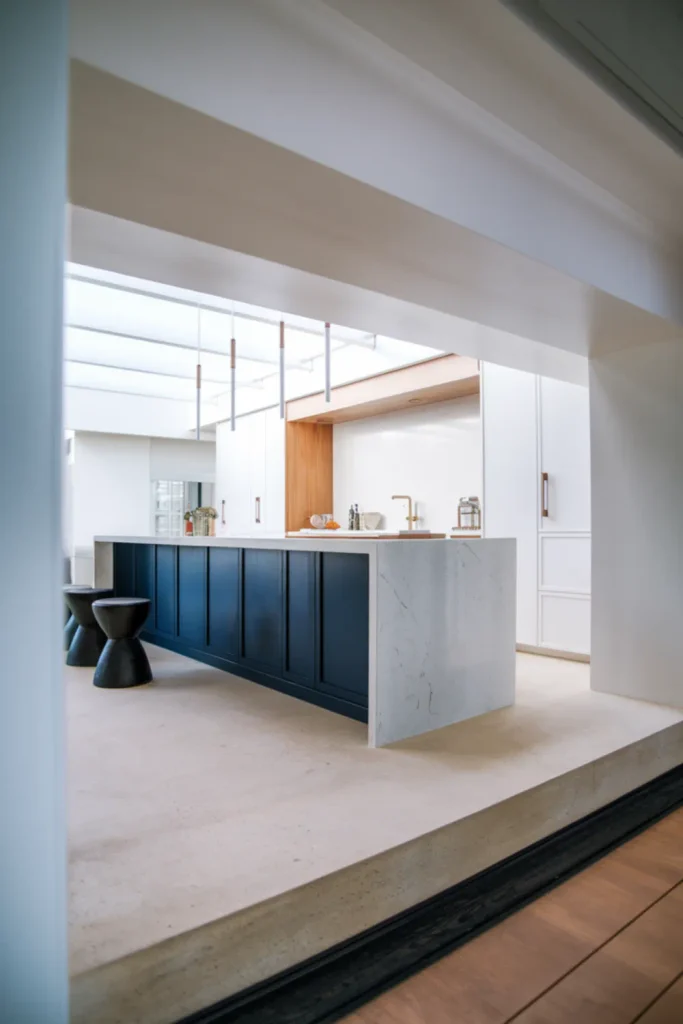
Let the island carry both the navy color and the strongest stone detail in a modern kitchen.
A white quartz waterfall edge frames the blue cabinetry and gives the long island a clean ending when viewed from an adjoining room.
Keep stools visually light so they do not hide the cabinet color or crowd the overhang.
Stone thickness and seam placement should be discussed before fabrication, especially on a large island.
Allow enough knee room and walking clearance rather than enlarging the feature beyond what the floor plan supports.
21. Navy Farmhouse Kitchen With an Apron-Front Sink
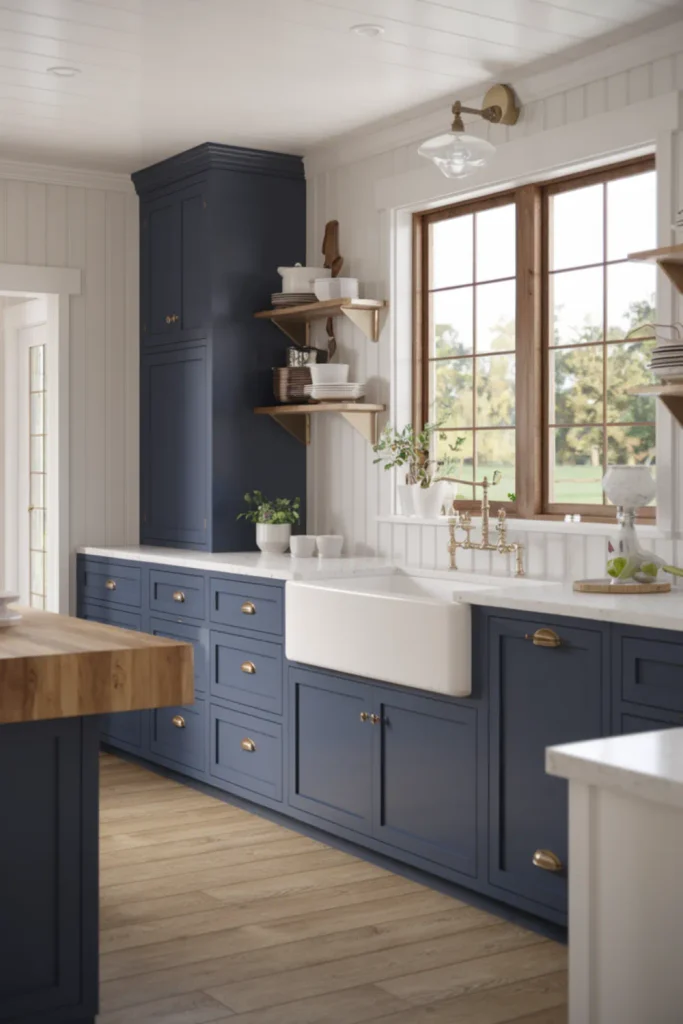
Nothing defines a navy farmhouse kitchen faster than a white apron-front sink set into deep blue base cabinets.
The pale sink breaks up the long cabinet run, while butcher block and aged brass keep the palette warm.
Because fireclay sinks are heavy, the cabinet below needs proper internal support before installation.
Measure the apron and cabinet opening carefully because sink dimensions vary between manufacturers.
Water-resistant counter material around the sink may be more practical than extending wood across every surface.
22. Rustic Navy Cabinets With Reclaimed Wood
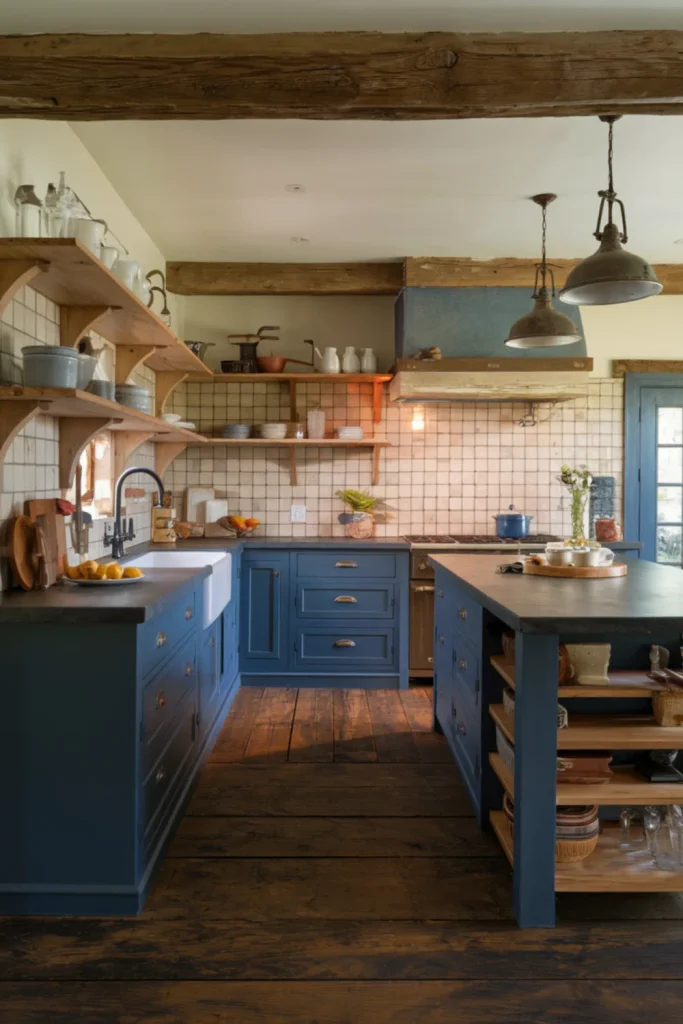
Weathered wood and honed stone keep navy cabinets from feeling too formal in a rustic kitchen.
Reclaimed shelves, exposed beams, and soapstone counters provide texture, but each material should serve a clear purpose rather than acting as decoration.
Clean and seal salvaged wood before bringing it near food-preparation areas, and check for old nails or unstable edges.
Limit the palette to navy, warm wood, cream, and dark metal.
Too many distressed finishes can make a newly renovated room look artificially aged.
23. Coastal Navy Kitchen Without Themed Décor
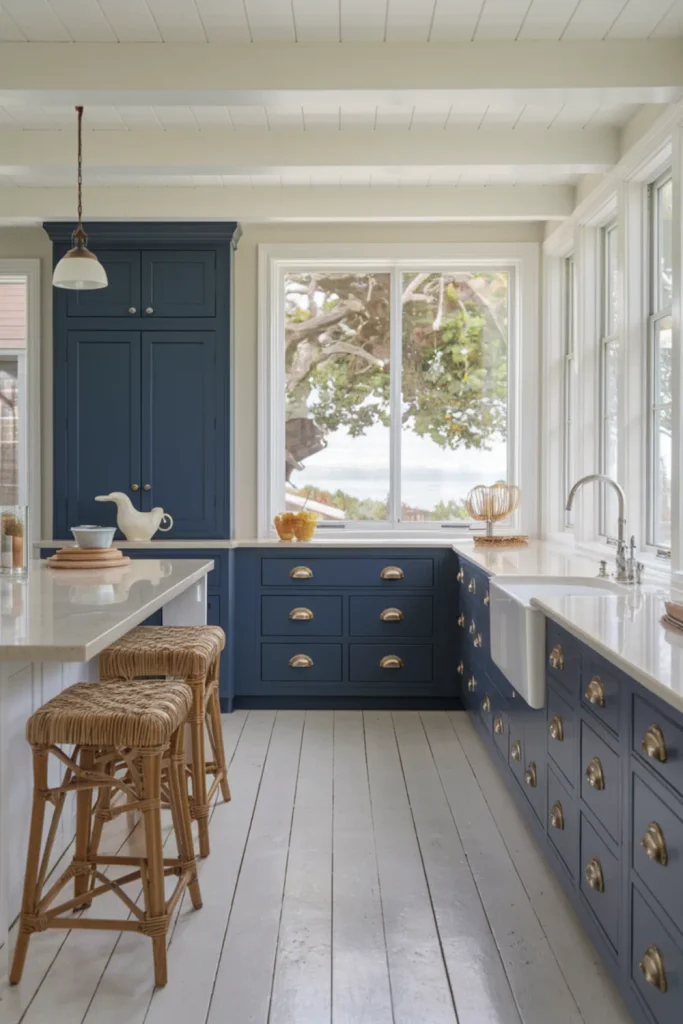
Skip the anchors, rope, and seashell accessories when styling a coastal navy kitchen.
Broad windows, pale oak floors, woven stools, and soft white walls communicate the direction more naturally.
Medium navy cabinets also hold up better across changing trends than a brighter nautical blue.
Choose materials that handle moisture and sunlight well if the home sits near the coast.
UV exposure can shift paint colors over time, so quality cabinet finishes and window treatments are worth considering in rooms with intense direct sun.
24. Navy and Soft Gray Kitchen Color Scheme
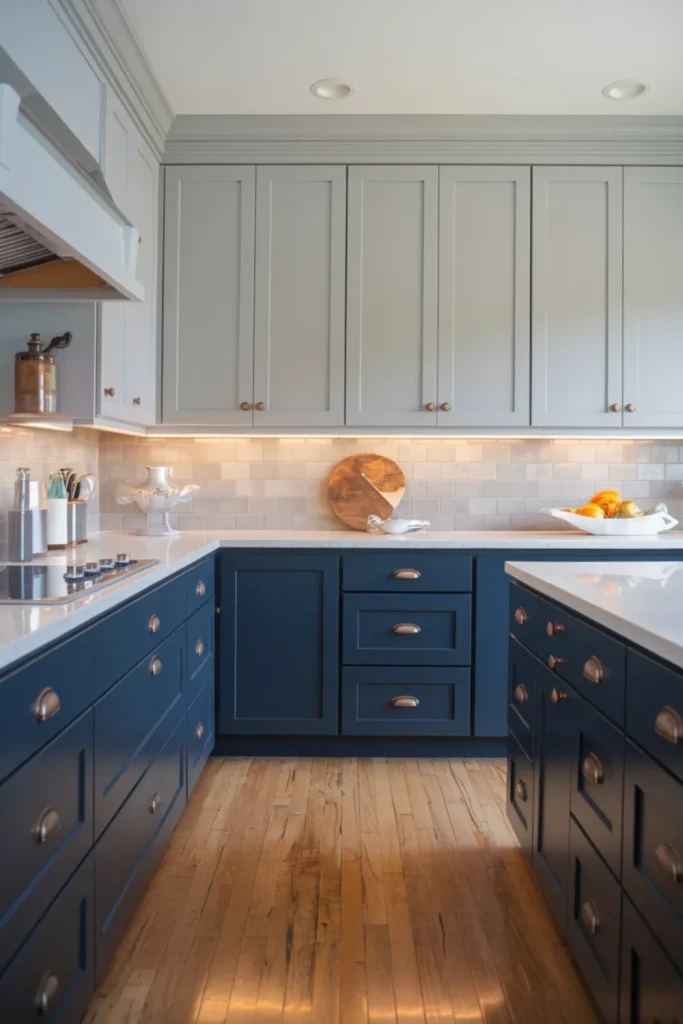
Gray softens the jump between navy cabinetry and bright white surfaces, making it useful for a layered two-tone kitchen.
Soft gray upper cabinets keep the walls lighter, while navy bases ground the work area and disguise everyday marks.
The challenge lies in coordinating undertones.
Compare large painted samples beside the countertop, flooring, and appliances rather than choosing each finish separately.
Warm gray works well with oak and brass, while cooler gray is easier to pair with stainless steel and brushed nickel.
25. Navy Cabinets Against a Black-and-White Floor
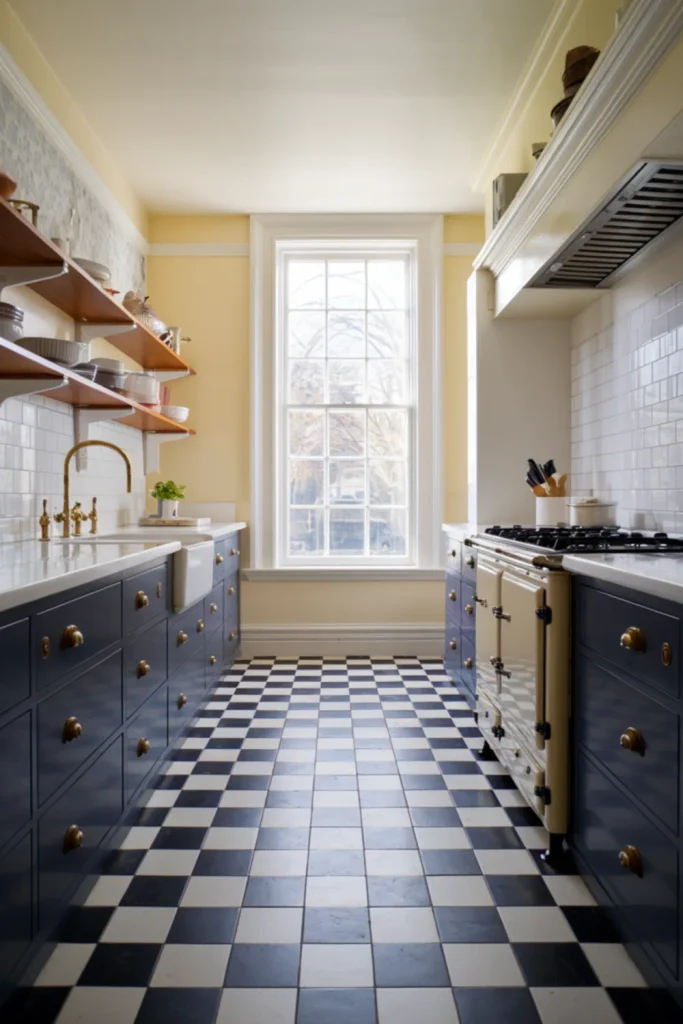
Few floors hold their own against navy cabinetry like a black-and-white checkerboard pattern.
The graphic grid suits traditional kitchens and renovated historic homes, while white counters keep the upper half of the room calm.
Tile size should reflect the room’s scale; very small checks can look busy in a large kitchen, while oversized squares may overwhelm a narrow one.
Lay out several rows before installation to avoid awkward partial tiles at visible edges.
Keep the backsplash simple so the patterns do not compete.
26. Navy Cabinets With a Patterned Tile Backsplash
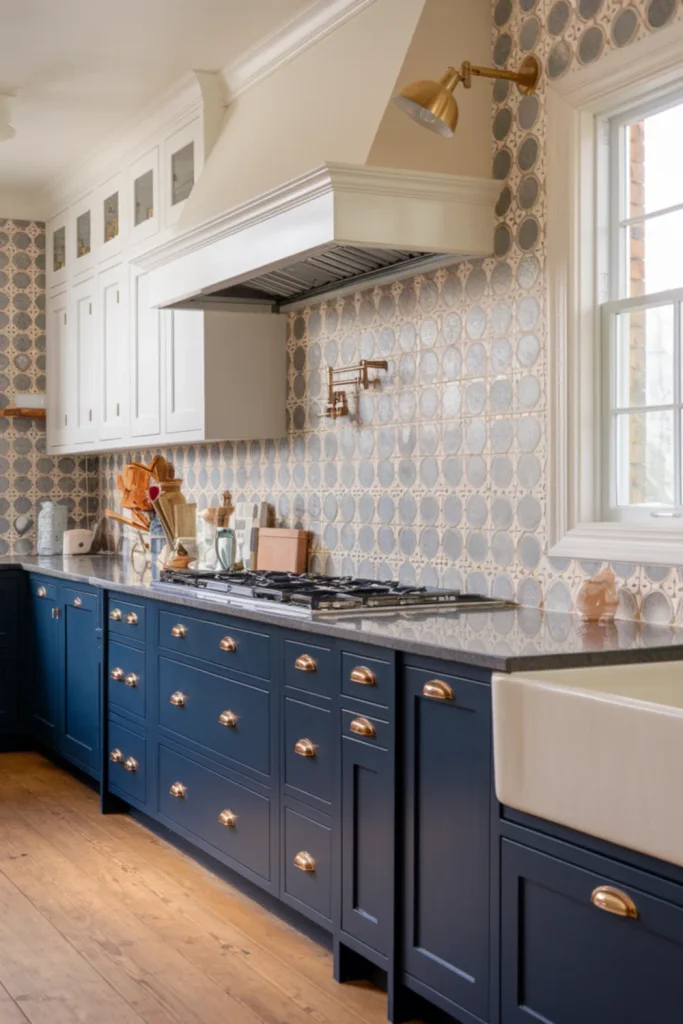
Pattern belongs in a navy kitchen when its colors connect the cabinets to the surrounding materials.
Muted blue, cream, and terracotta tile can bridge dark cabinetry with oak floors and brass hardware without relying on stark white.
Use the patterned surface on one main wall rather than wrapping every corner.
Before ordering, arrange several tiles together because individual samples do not reveal the full repeat.
A quieter countertop also gives the backsplash enough space to read clearly while keeping food-preparation areas from looking overly busy.
27. Dark Navy Cabinets With Warm Limestone
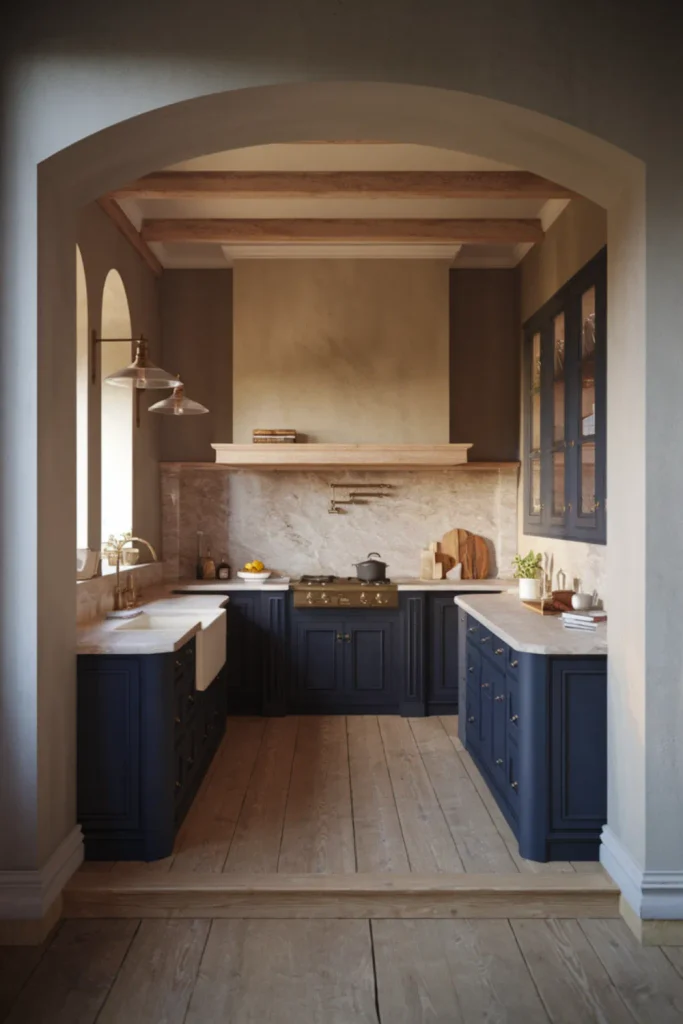
Creamy limestone moves dark navy kitchen cabinets in a warmer, earthier direction than bright quartz or marble.
Its soft color works well with oak flooring, plaster walls, and antiqued brass fixtures.
Honed stone is less reflective and suits the muted palette, but limestone remains porous and can stain near cooking and sink areas.
Ask about sealing schedules and appropriate cleaning products before committing to it.
Homeowners who prefer a uniform, low-maintenance surface may want a quartz alternative with similar warm coloring.
28. Navy Cabinets With an Exposed Brick Wall
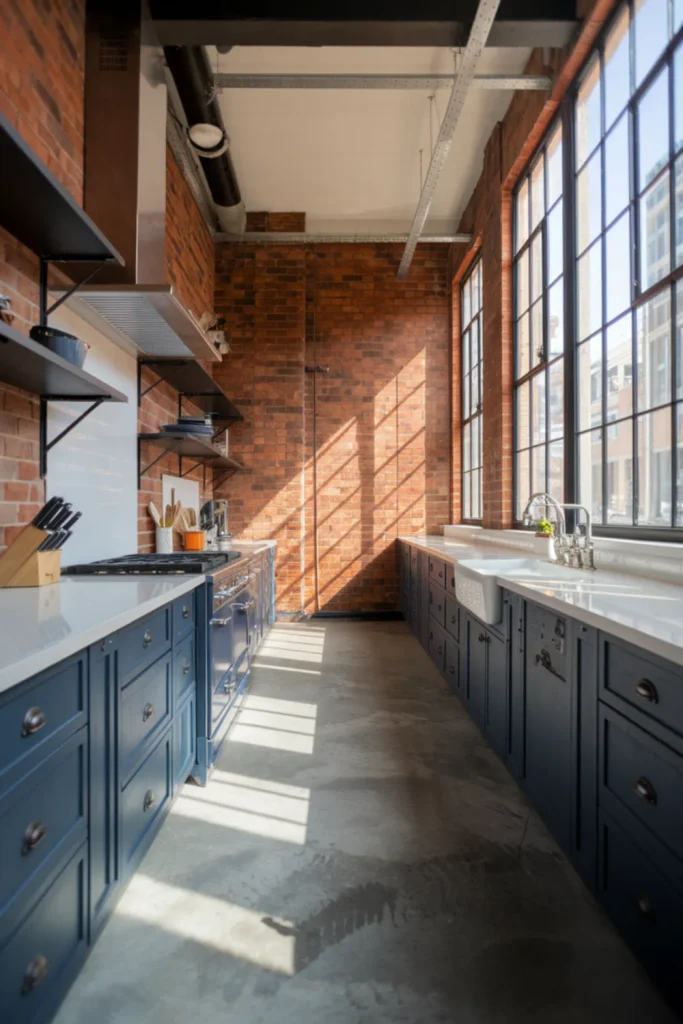
Original brick gives navy cabinetry a textured, warm backdrop that feels especially appropriate in lofts and older renovated homes.
Simple counters and restrained hardware allow the contrast between blue paint and red masonry to remain clear.
Brick near cooking areas can absorb grease and moisture, so sealing it may simplify cleaning without hiding its character.
Check the wall for loose mortar before installing shelves or cabinets.
Strong daylight helps reveal both materials instead of letting the brick and navy merge into one dark surface.
29. Navy and Natural Oak Two-Tone Cabinets
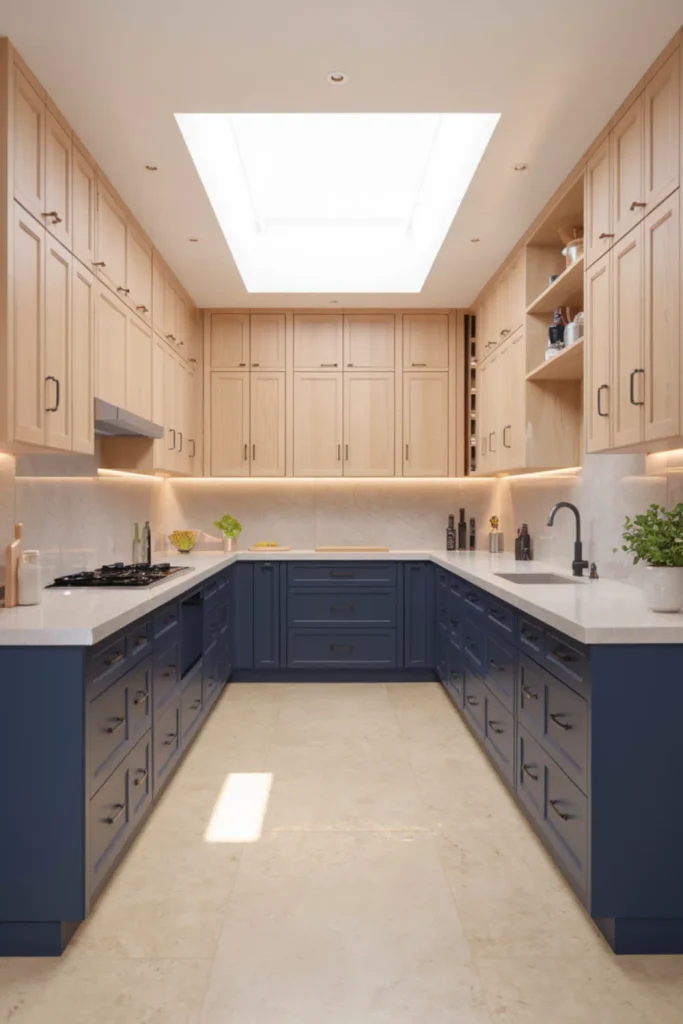
Splitting cabinet finishes by height gives navy and natural oak distinct roles within the same kitchen.
Navy base cabinets provide depth and hide daily wear, while oak uppers bring grain and warmth closer to eye level.
Choose a clear or lightly tinted wood finish so the oak does not turn orange beside the blue.
Matching every wood surface is unnecessary, but the undertones should relate.
Keep door profiles consistent across both finishes to make the arrangement look planned rather than assembled from separate cabinet collections.
30. Navy Kitchen Cabinets Styled With Greenery
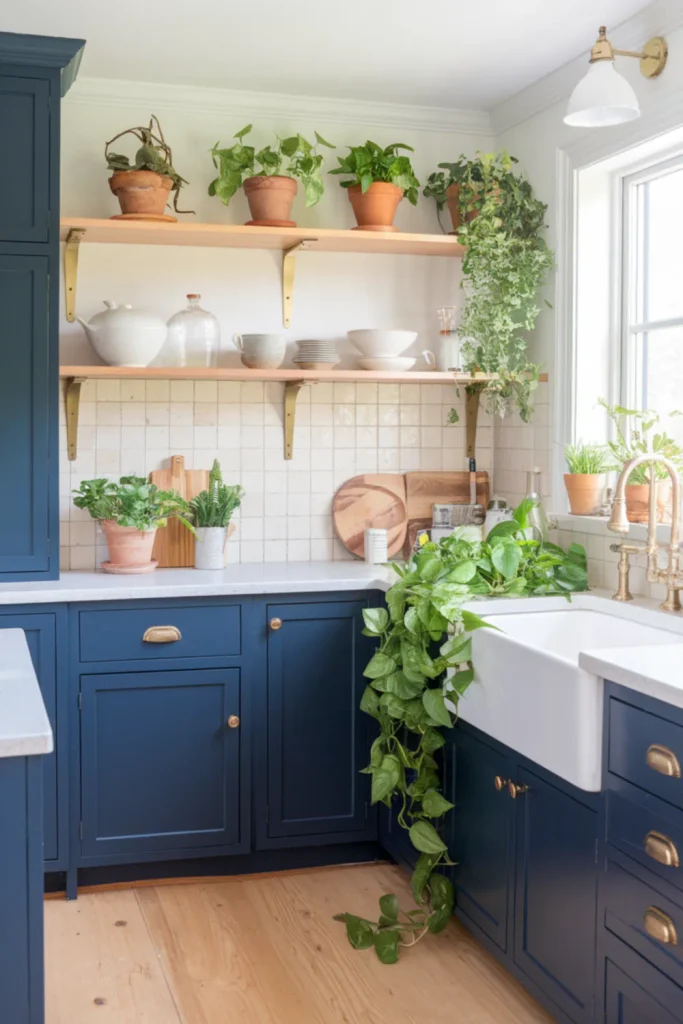
Greenery makes a navy kitchen feel less formal, especially when plants sit against white tile or warm wood shelving.
Trailing pothos can soften an upper corner, while potted herbs near the sink add a practical layer to the styling.
Match each plant to the available light instead of choosing it only for appearance.
Avoid crowding the countertop with small pots that interfere with food preparation.
Water plants away from unsealed wood shelves, and use saucers to protect painted cabinets and nearby surfaces from moisture.
31. Budget-Friendly Navy Cabinet Paint Makeover
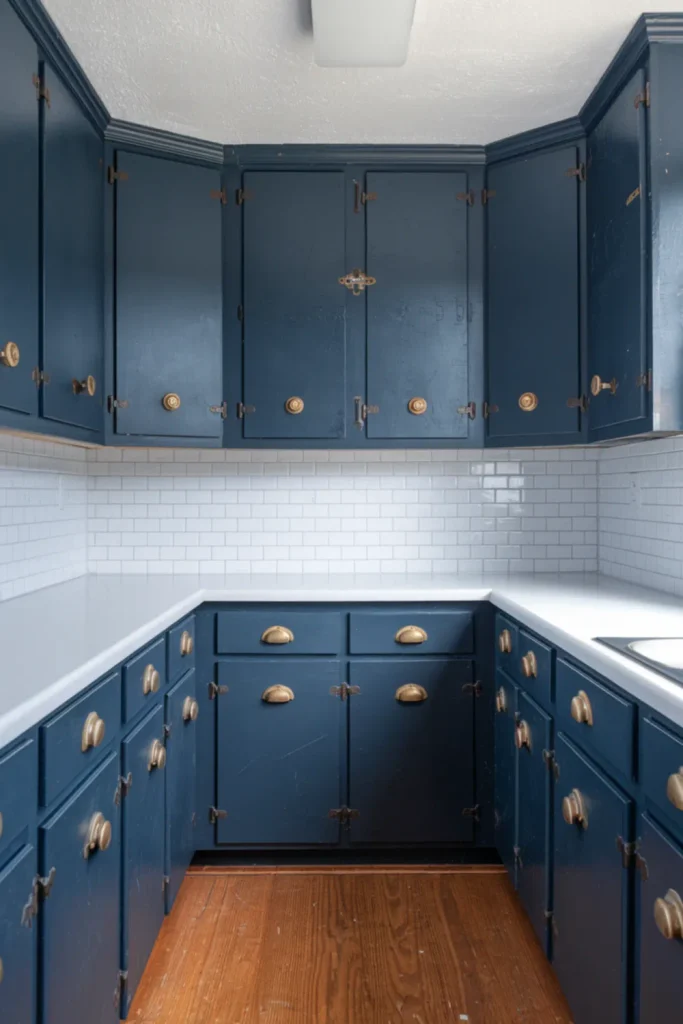
Good preparation determines whether painted navy cabinets look refreshed or merely covered.
Remove the doors and hardware, label every piece, clean away grease, and sand or degloss the existing finish before applying primer.
Dark paint makes dents and poor brushwork easier to notice under direct light, so repairing damage first is worth the extra time.
Use cabinet-grade enamel rather than ordinary wall paint, and allow the finish to cure fully before reinstalling hardware.
Structurally damaged cabinets are rarely good candidates for a cosmetic makeover.
32. Bespoke Navy Kitchen With Integrated Storage
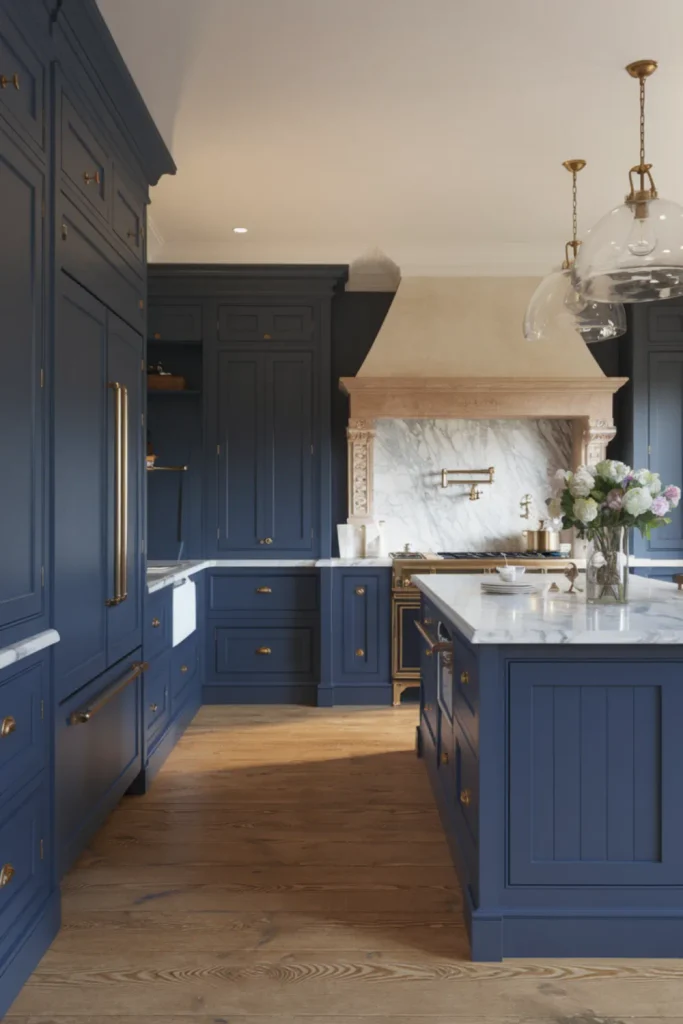
Luxury is most convincing when the cabinetry solves practical problems as well as looking refined.
Bespoke navy cabinets can conceal appliances, organize pantry supplies, and align door panels across an entire wall.
Internal drawers, tray dividers, charging outlets, and appliance garages should be planned around household routines before the exterior details are selected.
Marble, brass, and custom millwork provide a rich finish, but symmetry should not override usability.
Check door swings, countertop landing areas, and access to frequently used storage during the design stage.
Conclusion
Narrow your choices by deciding where the navy belongs first: throughout the kitchen, below the countertop, or on one focal feature.
From there, select counters, flooring, and hardware that provide enough contrast for the room’s light level.
Before committing to navy blue kitchen cabinets, compare full-size color and material samples together in both daytime and evening conditions.